

Bonjour. Today is Monday, June 1, 2026. Thank you for reading Podcast the Newsletter, let’s get into it!
xoxo lauren
🚨the one thing🚨
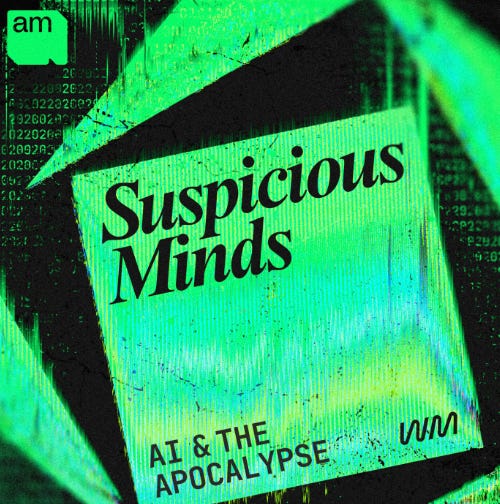
Season one of (the Webby-nominated, selected-by-Tribeca) Suspicious Minds, which focused on AI and delusion, was unsettling, deeeeeeply thought provoking, and well-researched. (And, side note, produced by Selina Gomez.) I especially liked hearing the firsthand stories of people who had fallen far far farrrr down the rabbit hole (one man’s bot convinced him he was Jesus,) which were handled more compassionately than I’d seen anywhere else. There was nothing like it. Well, the boys are back in town for season two, this time looking at toward the apocalypse, and this feels insane to say but I think it’s going to be even better than season one. We have been throwing the word “apocalypse” around literally forever but thanks to the climate crisis, the threat of nuclear war, epidemics, AI, Donald Trump, etc, it’s been more on our minds. Is the hype just hype / good marketing, or is the hype real, and if it’s real why are people being pretty chill about it? HUGE questions get thrown around (has the world already ended for some?) and there is a fun interview with a theologian about eschatology. There is so much overlap with AI and religion. In episode one we learn that the word apocalypse means the unveiling of hidden truths. It’s hard to think about, it’s hard to talk about. Maybe that’s why we haven’t done a great job doing it. But here, Sean King and Drs. Joel and Ian Gold are asking: is civilizational AI dread a form of collective psychosis, or something categorically different? AI is, depending on who you ask, going to make our lives better or end our lives entirely. Stay tuned you guys!!! And get on the Suspicious Minds train, I have been promised stories of crazy rich people and their billionaire bunkers!
Your Adventurous Friend: Blair Braverman
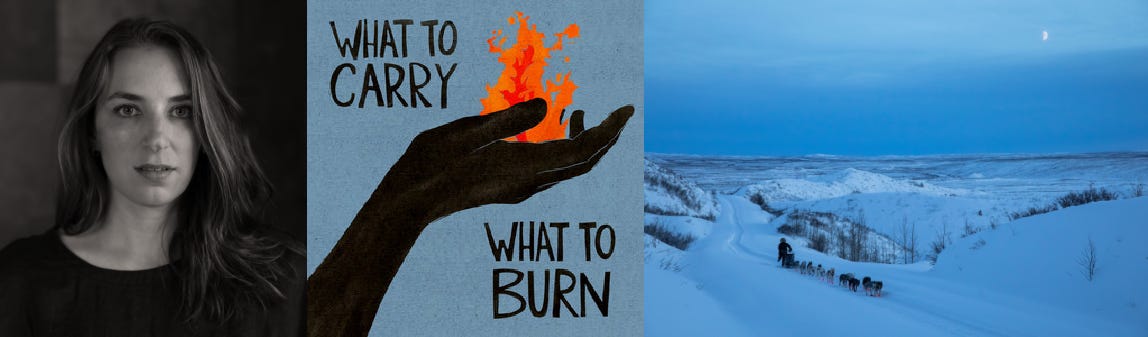
Blair Braverman is a bestselling author, adventurer, and long-distance dogsledder who has crossed thousands of miles of frozen wilderness by dog team. Her new podcast is What To Carry, What To Burn
What is your life like? I imagine you adventuring all over the place all the time, always outside, traveling all the time, always in extreme weather…is that it? Or is your life more normal than that?
It really depends! I’ve been so lucky with my life and career; I think of it as a balance between living stories and telling them. Sometimes I’m deep in the wilderness for months at a time, or crossing hundreds of miles alone by dog team. Other times, I’m more settled—that’s generally when I’m writing my books. Right now I have two-year-old twins, so my everyday life is a lot more stable and routine—which is why this is the perfect time for me to make this podcast.
Tell us about What to Carry, What to Burn in 10 words or less.
True stories about surviving the impossible, with lots of heart.
OK now you have more words!
I’ve always been obsessed with survival stories—not just survival but the way we talk about it, whether it’s in books and movies, survival reality shows, etc.
Stories of being trapped in the wilderness are often presented in terms of “toughness” (self-amputation! eating grubs!). Of course that’s part of the experience, but the real stories are much more complicated; they’re often more about love and extreme creativity than they are about hardcore endurance.
That means, of course, that they’re also much more human and relatable than people realize, especially if they don’t think of themselves as outdoorsy. What to Carry, What to Burn is about telling survival stories through that deeply human lens.
You will like What to Carry, What to Burn if you like ________. (Can be anything!)
…if you like sitting by the window on the rainy day.
I’ve loved hearing you on You’re Wrong About, your stories about survival always end up being about how people find beauty and joy even when, or especially when, they think they might die or find themselves in what seems like a hopeless situation. When other people talk about the Dyatlov Pass Incident, it’s usually a really sensationalized and gruesome retelling. That’s not your thing. Is it hard to find beauty in terrible stories or is it always there?
The more terrible an experience, the more its moments of beauty are cast into relief, and the more people have to cling to them. People in survival situations are also often desperate to make that beauty, whether that means taking in a wild animal as a pet, or creating art that they think no one will ever see. When I tell these stories, I want to be sure to capture those moments, too, rather than just the sensational horrors. Not to be too corny, but I think that’s survival’s greatest lesson for the rest of us, too.
What do you like about audio?
I love the intimacy! I think of this podcast as a chance to sit around a campfire with listeners, metaphorically. The kind of campfire stories that go late into the night, until only the coals are glowing.
notes

📌This year the International Women’s Podcast Awards are returning with a new team (us! Tink!,) new branding, a new location, and all the same love of the art of podcasting. Entries are now open for the 2026 awards through July 31st, 2026 and there are sponsorship opportunities.
📌Yesterday, Arielle Nissenblatt🎧 featured 5 podcasts to future-proof your career in EarBuds.

💎podcasts i texted to friends💎
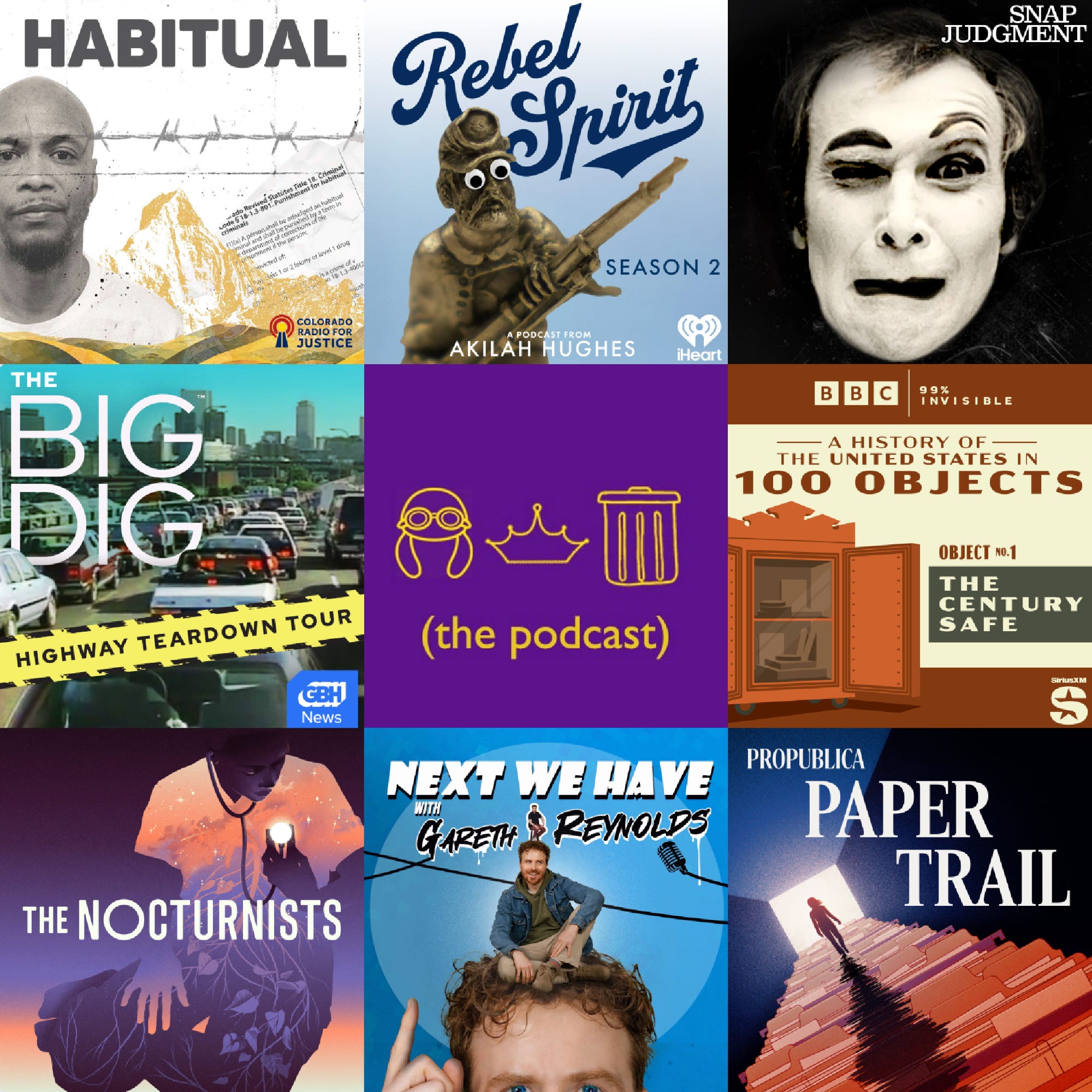
✨In season one of Rebel Spirit, Akilah Hughes brought us to her hometown of Florence, Kentucky, to try to convince her former high school to change its mascot from a Rebel into something less racist, specifically a biscuit. (Which sounds like a joke but actually makes sense when you hear Akilah’s compelling argument.) It was a funny, personal memoir packed with texture and conversation, and a bit of a travelogue that was well researched and really just a totally creative history lesson that didn’t feel like one. Season two is here and it goes bigger—to monuments, public memory, and who gets celebrated in American culture. Because elsewhere in Kentucky lurks a battle over a Jefferson Davis statue that stood in the Kentucky State Capitol, in the same rotunda as a Lincoln statue. That’s Jefferson Davis, the EMBARRASSING president of the Confederacy during the Civil War. His legacy was: slave-owning plantation farmer who went on to destroy the government and become a traitor of the country who was mocked nationally in newspapers for hiding under his wife’s shawl as he fled in the middle of his breakfast. (Yes, the fact that his statue was hanging out with Lincoln’s is historically confusing.) The Davis statue was taken down but nobody can decide what should replace it. Will anything replace it, or is the rule racist or nothing at all? Is nothing being there symbolic? Just like last season, Akilah brings us along in her pocket, kind of, to Kentucky, uses voice actors to brings to life historical scenes, and gets Kentucky Governor Andy Beshear and Kentucky State Senator Chris McDaniel on the horn to talk about not just what to do about the Kentucky rotunda but how we should memorialize a history we aren’t proud of. I will say there were so many iHeart ads I kept getting distracted and almost gave up listening, it’s so irritating. But this is a good show, it’s worth it. Start with “Back to Work” here.
How I discovered it: Subscriber
✨Paper Trail is a new podcast from ProPublica about huge governmental wrongdoings that make you want to throw up your hands and die, focusing on the way that ProPublical journalists have actually chased down evidence, uncovered hidden facts, conducted secret conversations, and put themselves in general danger to do something about it. Jessica Lussenhop is a strong host, she feels personally tied to each story (which so far have covered the FDA lying about generics, a towing company kind of stealing people’s cars, and insurance denial.) The episodes are not only fascinating stories that reveal terrifying loopholes in our systems, but explain how investigative reporters are super hero-ish. I mean I’m kind of obsessed with the idea of a show that is so smartly able to entertain me, enrage me, calm me, and also make me want to kiss a ProPublica journalist on the mouth all in one. Their work shapes laws, ends corruption, frees innocent people from jail, and saves lives. With media companies and news rooms shutting down faster than you can say “extra extra read all about it,” it’s a good time to be reminded what journalists are doing. Listen to Paper Trail here.
How I discovered it: I think I saw it trending somewhere
✨I was entertained and completely moved by a recent piece on Snap Judgment, “Silence Speaks,” about a mime who used his art as a form of resistance living in Stalin’s Soviet Union. We meet Grigory Gurevich in his New York City apartment where he tells us the story about his life in Russia in the 50s, when speaking out against the government was dangerous. But there was a loophole, a way to criticize the government. Miming. Listening to Grigory talk about the way he communicates with comedy and strength and creativity feels magical, it almost made me cry. This story felt like it was sparkling with magic. Grigory gets to work with this guy, Marcel Marceau, a legendary mime-to-know, who has this haunting performance called The Mask Maker, that he started doing in the late 50s but has so much relevance to today it’s insane. Marceau pretends to try on a series of invisible masks—happy, sad, proud, flirtatious—changing his entire face and body language instantly with each one. But then he puts on a smiling clown mask that becomes stuck, and even as the character grows frightened and desperate, the grin never disappears. EERIE.) Listen to “Silence Speaks” here.
How I discovered it: Producer John Fecile emailed me about it, which he does occasionally, and I love it. Producers, email me the work you’re proud of!
✨I have always been a bit embarrassed how much my work defines me, or that when I meet someone at a party I ask them, not because I don’t know what else to say but because I’m actually curious, “what do you do?” But like, it’s interesting. pilot. princess. trash collector. is proving that to be so. Host Nick Andersen asks people three questions: what is the first job you wanted to do? What do you do now? What happened? I love following this trajectory but that’s not the only reason I’m excited about this show. Nick is one of the guys behind Ministry of Ideas and Hub & Spoke. He cares about exceptional storytelling and sound. Episode one, where Nick answers the questions himself, combines both of those things gorgeously. It’s not about just the answers to these questions. It’s about how we tell stories about what we do, and who we are. I love how Nick says, in episode one, “I want to ask these people the questions and see what happens.” I think it’s going to be good. Listen to pilot. princess. trash collector. here.
How I discovered it: Email from Nick when Arielle and I were soliciting things for Podcasts We Text About (the 10 Podcasts We Can’t Wait to Hear This Spring🪻 edition)
✨I never would have thought that I could use the word “gripping” to describe a podcast about infrastructure, but here we are. Season one of (Peabody-winning) The Big Dig was that. Not only did Ian Coss turn the story of a complicated city project into a compelling human drama full of history, personality, and twists and turns, it stirred up something universal: that every American city is divided by a crumbling highway, and every city is trying to figure out what to do about it. Boston is not alone. So Ian went around the country hosting live events (for a series he’s calling “The Highway Teardown Tour”) in places like Seattle and Providence and places between, telling their Big Dig story with residents and representatives. Which incomprehsnsibly complicated piece of infrastructure is about to fuck them? Trust me this is fun and such a cool idea for a series. Episode one, about the BQE, was an inportant piece of history I feel like I should have known that had me browsing photos of triple-cantilevers for 30 min. Listen to ”Highway Teardown Tour | 1. New York, NY” here.
How I discovered it: Subscriber, listen to Ian’s stuff
✨On the medical storytelling podcast The Nocturnists, Emily Silverman interviewed Susan Wise Bauer, author of The Great Shadow, for a sweeping history (from ancient times through the Middle Ages, the seventeenth century, up to the present) of not medicine, not disease, but what it actually has felt like over the centuries to be sick and how actually being sick or even being afraid of being sick throughout the years has overlapped with society, culture, and politics. I don’t think about medicine a lot so for me this seems like a hugely powerful force that is pretty unexamined. We know about medicine and disease, but isn’t it more important what people perceive, understand, and trust? Hearing how philosophical thinking impacted what we believed was going on with our bodies isn’t just fascinating but Susan explains how that literally changed the ways we built our cities and lived our everyday lives. It makes sense, but have you ever really thought about it before? I loved hearing about it, and also how Susan wrote the book. She had to take a bit of creative license, because what it felt like to be sick is hard to track, though she takes guesses by examining The Odyssey and looking at other even-older sources. It’s clear that while so much has changed when it comes to sickness, also so much hasn’t, including the interplay between our personal experiences and how much weight we give to authority and the doctors telling us we are or are not sick. Illness has always fed into culture and vice versa. We are still racist and stupid when it comes to what we believe. (And this all seems incredibly relevant now thanks to RFK Jr.) Listen to “The History of Being Sick with Susan Wise Bauer, M.DIV, PhD” here.
How I discovered it: Subscriber, and The Nocturnists was one of my first clients years and years ago.
✨Herbert Alexander was once incarcerated under Colorado’s three-strikes law, which labels certain people as “habitual criminals” and sometimes triples or quadruples their prison sentences, if it doesn't just straight up put them there for life. Someone mentioned in this episode got a 300+ year sentence for writing a fraudulent check. A slew of other people accepted weak plea deals just to avoid it. Herbert robbed a bank and was sentenced to 64 years instead of what usually would have been 16. He’s out of jail but it took some fighting, but not everyone else will be able to do that. Along with co-hosts Seth Ready and Ryan Conarro, Herbert’s a producer of the new podcast HABITUAL, a podcast from Colorado Radio for Justice, which digs into this law. I don’t think I knew how much fun it could be to listen to a podcast on a single law. But HABITUAL is a weaving of voices, music, storytelling and sound—the production is incredible. Herbert Alexander makes this super engaging and the conversations he has all add something to the conversation. It also zooms out with history (are we surprised this law is rooted in eugenics?) and asks big questions like…what is the purpose of the criminal legal system, anyway? What is the purpose of corrections? Who needs punishment, who needs rehabilitation? It’s hard to imagine how many people have been impacted by this law or how much money it has cost taxpayers. This show also doesn’t fuck around, it’s five wonderful episodes. Each one worth your time. I could not stop listening. If you told me it was made by the Ear Hustle team I would have believed you. Listen to HABITUAL here.
How I discovered it: Tink had a Podcast Threapy session with them
✨To celebrate America’s 250th, 99% Invisible (and BBC Studios) is doing something enormous—telling 100 stories, one at a time, each an ode to an object that tells us something about America. It’s a huge time capsule of stories! And we start with a time capsule, too. The first object is The Century Safe, which in 1876 was filled with stuff that citizens believed would be important and was opened 100 years later. With Jill Lepore as a guest, we hear a funny story about how disappointing it was for the people who opened the safe in 1976. A photo. A pamphlet. An inkwell. But I’m surprised anyone was disappointed. It’s fascinating that these are the things early Americans wanted to send us. (Roman explains why they’re more interesting than they sound.) This sets us up to ask…should Roman be doing this again? How do we choose the right items? Should a screw thread be the second episode? Because it was, and let me tell you…I have never thought about screw threads (“simple device ties together the mechanical skeleton of our civilization!!!”) so much before, or really at all. It’s a technical episode but also a story of standardization and the way the US has remade the world or the way the world has had to remake itself to accommodate the US. Start with “100 Objects #1: The Century Safe” here.
How I discovered it: Subscriber
✨Next We Have, Gareth Reynold’s podcast full of podcast segments, was one of my favorite new podcasts of last year, so of course it has already been cancelled. (I have weird taste, I guess. Why do you read this newsletter?) Gareth will be FINE, he still has The Dollop and Here to Help and a million other things, I am not worried about him. It appears this show might have been an experiment that did not meet expectations. He mentions, in this final episode with Dave Anthony, Hannah Pilkes, and Steve Berg, that we should tell our friends about the show if we want it to return and that it might. So I’m telling you all here. I wish I had more specific instructions to bring Next We Have back to life. Is that going to be what changes everyone’s minds? Is there a petition I can sign? Anyhoo, if you haven’t listened to this show start with episode one and don’t stop. Don’t start with the final episode, it is the weakest. Gareth even admits that the last segment of the podcasts is one Gareth doesn’t advise we listen to, and that’s not a joke. Start with “Holiday Inn & Out with Lisa Gilroy” here.
How I discovered it: Browsing the Headgum website for no reason, which is something people rarely do but they should.