

Bonjour. Today is Monday, October 26, 2026. There are 143 days until my next Disney Cruise.
xoxo lauren
🚨the one thing🚨
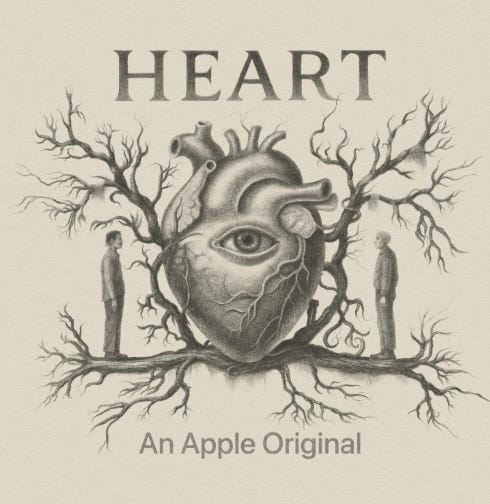
Crazy story for you: This guy, Sonny Graham, receives the heart of Terry Cottle a guy who died by suicide, then reaches out to Terry’s widow Cheryl. The local papers write about it as a romantic love story, but friends and family say that Sonny changed drastically after the transplant, and then, get this, he dies by suicide, too. Weird, right? Is it a coincidence? Can a transplanted heart carry its previous owner’s trauma? Or is Cheryl a sociopathic murderer? Heart is an investigative podcast hosted by Karen Kilgarrif that spends hours talking to Sonny’s family, Terry’s family, some people who worked the original cases, medical experts, and eventually two private investigators who look into whether or not the original cases were botched and Cheryl is a murderer or not. It spends eight pretty long episodes kind of hinting that she is, but that’s only because we get SO MUCH from the Grahams and the Cottles, two families who are sure she murdered Terry and Sonny. (Nobody wants to believe their family members would kill themselves, it’s always more comfortable to think they were murdered.) There is nothing from Cheryl or anyone on her side. That’s the thing I was screaming about the whole time I was listening. Cheryl sounds like a true nightmare. She was married to many men who confirm this, she seemed screamy and super comfortable with aiming guns at people and threatening to kill people, she sounds cold and materialistic. Some of that we learn from records (many marriage / divorce certificates) but some of that we hear from an army of people who hate her. (They all are sure she didn’t grieve appropriately, which makes her guilty in their eyes.) It doesn’t seem fair and by the end I had painted a picture of her like a Disney villain, an Ursula or Cruella, that you kind of have to love, or at least wonder about, or at least want her side of the story. But in Heart, we do not get that. What we do get, and it’s stretched out over a long and kind of confusing timeline, is all of Cheryl’s relationships and the lives and deaths of Terry and Sonny. (I actually felt like there was a lot of over-explaining about who everyone was, and I started to worry this podcast was made specifically for people not paying attention that much, I believe this is called the second-screen viewing or The Netflix Effect when it comes to TV.) Listen: I was on pins and needles the whole time listening. I was late picking up my daughter from school because I didn’t want to hit pause in the last final minutes of the final episode, and when I eventually did have to hit pause, I couldn't stop thinking about when I’d get to hit play again. There are interesting conversations with heart experts who believe that the heart keeps the score and that suicidal tendencies could transfer from one body to another through the heart. And some who do not believe that. Suicide is explored, why people do it, what factors make it likely. Several times the show says “OKOK this heart theory, that Sonny killed himself because of Terry’s heart, is probably bunk but just imagine it were true.” The show admits it’s not likely but more a thought exercise that I enjoyed. But the elephant in the room was: where is Cheryl? (And also, I might add, why is Karen hosting this? I prefer when people who did the research and reporting host, not someone famous for making a long-running, completely different murder show.) In the end, this show does deliver. I’m not going to spoil it but when two independent investigators are hired to really look at the cases to determine whether or not they were botched the first time around is illuminating. One of them is a man, but wait for the woman’s report. She offers a theory that seems to be the one these families do not want to hear but that, IMHO, is probably true. I kept getting that Todd Rundgren song in my head, “The Ballad,” that sings: “No one can tell what's in a heart.” But really, sometimes we do kind of.
notes
📌Tenderfoot turned the best Radio Rental episode into a stop motion LEGO-inspired documentary short film. CHILLLLLSSSSSS!!!
📌Yesterday, Arielle Nissenblatt🎧 featured Halloween podcasts in EarBuds.
📌Cultureverse, an original cultural-adventure podcast created by my friend Lory Martinez’s Studio Ochenta (that I worked on years ago!) is returning in a new format with The Cultureverse Print, a monthly print club that adapts the series’ stories into illustrated reading experiences, language-learning activities, and collectible art. It’s a beautiful experiment in extending the life of existing IP beyond its original audio format, reflecting a growing opportunity for independent creators and media companies to develop new revenue streams from their existing catalogs, using more accessible production and distribution models to bring established stories to new audiences. Pre-order now.
~sponsored~

An independent therapist’s podcast just hit the top of Apple’s ‘New Shows’
PodVision partnered with Kristen Plake a few weeks ago to launch ‘Women Under Pressure,’ and it has already climbed into the top 20 on Apple’s Mental Health chart. At PodVision, we use a 360 Strategy to deliver this kind of result for mission-driven businesses launching or breaking through growth plateaus. It’s the same 360 Strategy our partners used to reach #1 in Health & Wellness, win a Webby, and grow listenership over 100x.
💎podcasts i texted to friends💎
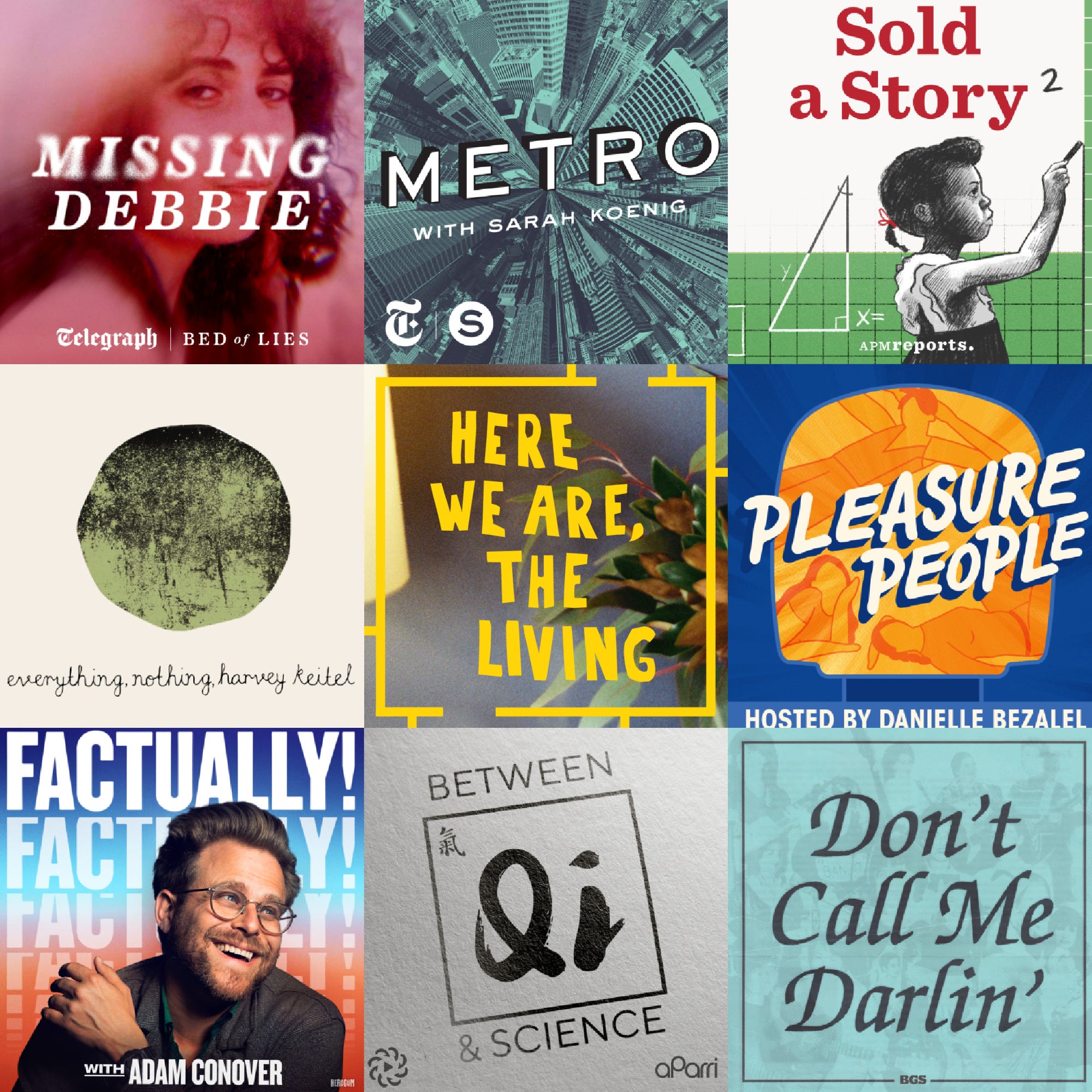
✨I have written about Eleanor McDowall a million times, and I’ll probably write about her a million more. She’s an award-winning audio producer, the mind behind Short Cuts and the founder of Radio Atlas. She has impeccable taste and a gift for making sound do things you didn’t know it could do. Her new podcast, Falling Tree, is a treasure trove of nearly 30 years of the Falling Tree archive. For “Everything, Nothing: Harvey Keitel,” Danish poet and radio producer Pejk Malinovski tries to meditate in a NYC yoga studio but is so distracted by fact that Harvey Keitel is there that he cannot. We are in deep with his thoughts, which cannot focus for one second, it is a hilarious, ongoing joke that almost becomes a game to see how he draws everything back to Harvey Keitel. The sound is surreal. We dip in and out with him, there’s breathing, the instructor, his own whispered thoughts which are hilarious, his imagined conversations with Harvey Keitel, constant reminders to himself to get back to the meditation, and the clips of Harvey Keitel’s work. This show is a protest against the slop we hear and now see, everywhere. (Although! Falling Tree is on YouTube.) This is not what the algorithm thinks you want. Listen to “Everything, Nothing, Harvey Keitel” here.
How I discovered it: Email from Eleanor, I kind of forgot about it, then noticed an episode was dropped on The Truth’s feed
✨Four years ago, Sold a Story exposed how American schools had embraced reading instruction that wasn’t backed by evidence. It was shocking and helped spark new laws in at least 26 states. If season one was about insiders were wrong, season two is about an outsider who was right. Emily Hanford introduces Zig Engelmann, an educator who believed any child could learn if teachers explained things clearly, broke lessons into the right steps, and practiced until kids got it. In his 1960s preschool, Black children from low-income families were learning algebra before kindergarten. But Engelmann’s approach, called Direct Instruction, clashed with the mainstream philosophy that children learn best by exploring and discovering things for themselves. That’s the central conflict of this season: Should teachers teach children what they need to know, or guide them toward figuring it out themselves? It’s a complicated issue with high stakes, especially for kids who can’t count on extra help at home. Emily gets teachers and students on mic to explain what it felt like to be inside these classrooms. It felt like magic. It felt cinematic. I felt like I was watching scenes in a heart-tugging movie montage about education reform. Obviously there are critics and problems, too, and that is what keeps you at the edge of your seat, once again, through every second of this series. The team is doing some remarkable stuff on YouTube that seems to really be working. I would watch this video on Direct Instruction before you listen, or like right now, even if you’re only curious about how investigative/narrative series are getting big YouTube numbers. Listen to Sold a Story here.
How I discovered it: Subscriber, got a few nice notes from the team.
✨The description of the new season of Bed of Lies, Missing Debbie, sounds super crazy and flashy and kind of like true crime catnip. We hear about Debbie Cooper (spoiler alert: RIP Debbie) who marries Jamie Starbuck, who sounds like a real psycho dickhead who none of Debbie’s friends or family likes. They go on this honeymoon around the world. TWO YEARS later, her friends get suspicious about their communication with her, all weird emails, and start asking questions which lead them to the discovery that they were emailing Jamie the whole time. He had murdered her a week after their wedding then spent three years pretending she was alive and happily traveling, sending emails to keep her family and friends off the scent. Investigating at the request of Debbie’s sisters, the reporter digs through archived police files and tracks down people who knew the couple to piece together how this almost impressively elaborate lie held up for so long. It’s a horrifying story that will probably make you think of at least one person you know who married or dated for way too long someone who was a parade of red flags that they couldn’t see. You might have worried. As you should. Cara is telling a much bigger story, about domestic abuse and control. I also kept on thinking about confidence. The mostly women I know who have fallen into this trip have lacked confidence, their psycho partners filling a gap for them. I always talk about how my mom gave me confidence, probably way too much of it, and how that saved me in so many incidents as a kid. I was saved by knowing who I was, liking that person, and not caring what others thought. I want that for my daughter, because this story YES, is juicy (and yes, the podcast will keep you on pins and needles for every SINGLE second) but carries an important message about the consequences of getting lost in someone else. I am not blaming Debbie’s family for taking three years to figure this out. Someone else surely should have. But I do think that this show is a reminder that it is on us as loved ones to say something if we see something. (I don’t know if it’s a British thing to be so polite, but Debbie’s family was a little “none of my business!” about how shady Jamie was when Jamie and Debbie were dating, and how shocking Debbie had been acting. In my friendship circles, it has taken far less to be upfront with a friend about their shitty dating choices.) Coercive control isn’t just a red flag, it’s a crime. In the UK and Wales, anyway! You can get away with this and other kinds of violence against women in the US pretty fine. But back to Bed of Lies, Cara really spent time on these people, she brings us with her on all the conversations she had with them, and made what could just be a surface “wow that’s fucked up” story to one that is memorable and important. Listen to Bed of Lies: Missing Debbie here.
How I discovered it: Pitch letter
✨I lived in New York City for almost 20 years, and when I moved away I went through a period of time when I could not read or listen to New York stories. I thought it was because I was trying to assimilate to my new city but I now know it was because I missed New York, it was too much to bear. I love everything about New York, sometimes for the things that make people hate it. The people, the chaos, the grit. I also love local stuff in general, so I am very excited about Metro with Sarah Koenig, a new thing with Serial Productions and The New York Times Metro desk, that explores the stories of the city. The episode I listened to takes us to TraxNYC, the Diamond District jewelry store that went viral after footage of a fight inside spread online. Sarah is a good reporter and observer, and honestly I just love her on the mic. I love picturing her hanging out in this weird Diamond District store with these total characters. I love what a weird place this was to start. I’m not sure what this tells me about New York or New Yorkers at all. But maybe that will come with more episodes. Because the video is top-notch, with a thoughtful visual approach that is way more ambitious than the usual podcast footage repackaged for YouTube. It’s a cool way to experiment with audio and video, even if I’m not sure the storytelling has figured out what it’s trying to do. Listen to METRO with Sarah Koenig here.
How I discovered it: I think I first heard of it at On Air Fest
✨If you have talked to me for more than 5 minutes there is a chance you know that I am obsessed with Danielle Bezalel (DB, of Sex Ed with DB.) She is smart, thoughtful, kind, hosty, funny, curious, wonderfully unembarrassed about all this stuff, and just so cool. (I often tell my daughter I want her to be exactly like DB.) Now she hosts a new podcast that is this incredible combo of her hostiness, some great production, and a fascinating study of 1,000 people who tracked their pleasure over 21 days, including an abstinence period and a week of regular Magic Wand vibrator use. The six-part series follows eight participants through the experiment, exploring what pleasure might do for stress, sleep, confidence, and intimacy, and the stats reveal some interesting things you might not expect. There’s an entire episode dedicated to the abstinence period, and all of the participants had different ideas about what abstinence was, and for some of them, this week was almost unbearable. But DB gets into America’s weird, enduring obsession with abstinence and the shame we’ve attached to self-pleasure. But really, this podcast is about people. I love being nosy, and getting to hear these people be completely honest about something not enough people are talking about is very cool. Dr. Candice Hargons and renowned sex educator Emily Nagoski join DB to flesh out the findings even more to learn about how studies are conducted, the hidden things the numbers mean, and most importantly, about people, and our own bodies, minds, and beliefs about the incredible potential of pleasure.We spend so much money on what is making us sick or very expensive ways to make us better. Pleasuring yourself is un-Christian, anticapitalist, free! No wonder it isn’t pushed on us. Here’s our chance to explore the pieces we’re missing. Listen to Pleasure People here.
How I discovered it: Tink client
✨Readers of Podcast the Newsletter know I love religion, wanted to go to divinity school, love Jesus, but am skeptical of it all. The friction and tension of that is why I love it. I am ALSO skeptical of medical stuff. I do not believe in getting sick or hurt, and I can almost, almost always convince myself I’m not. I don’t think this is a good quality of mine, and it comes to head a lot when I’m arguing with my husband about going to the doctor. His dad IS a doctor, the whole family believes in traditional medicine, but they’re Taiwanese so they took Eastern medicine seriously, too. When my daughter is sick, I tell her to walk it off and Justin whips out a new medicine kit I didn’t even know we owned. (I know how bad this sounds.) OKOK so Between Qi and Science is basically my catnip. (Catnip is bullshit also.) Host Kin Cheung, a professor of East and South Asian religions, investigates his father, a Cantonese immigrant and former sweatshop worker who became a self-taught healer in Brooklyn. By telling his story he takes us down rabbit holes that explore qigong, acupuncture, Buddhism, placebo research, and one question: What if science can’t measure everything that matters? What works for us and why does it matter? This podcast offers us the opportunity to think deeply about that. Kin isn’t pitting Western meds and Chinese healing against each other, he’s asking what happens when we take different systems of knowledge seriously, and why we’re so eager to declare some forms of healing legitimate and others nonsense. This podcast is pretty bare bones, it almost feels like an audiobook. You gotta focus, it feels like medicine itself at times. But it’s helping me organize so many thoughts I have had. Nothing feels too untethered thanks to the storytelling. This is also a family story, a religious one, a story of immigration, and a challenge to the idea of everything you have believed about medicine. I think this show is work to listen to, but doing something big. Listen to Between Qi and Science here.
How I discovered it: Pitch letter
✨When Alex Steed emailed me to tell me he was working on a new podcast, my ears perked. Alex is the host of You Are Good, the feelings-filled movie podcast he started with Sarah Marshall. But he does all these incredibly cool things in music and photography. And he’s a longtime champion audio that brings in outsiders and other cool people. He sent me Don’t Call Me Darlin’, an eight-part series from Carolyn Kendrick (the former lead producer behind You’re Wrong About) and Nashville musician-historian Tristan Scroggins. The show digs into Women in Bluegrass, a feminist zine that chronicled women navigating the boys’ club of bluegrass decades before the internet made it easier to find your people. We often think of Riot Grrrls when we think of groups of people who use music, DIY zines, and a certain boldness to challenge misogyny in their scene. But Carolyn and Tristan introduce us to the the women profiled in Women in Bluegrass’ pages to take us back and tell us what it’s like, ask what’s changed and what hasn’t. This is not only a story about bluegrass, it’s about a community of cool women brought together by music to do something positive and impactful on the sexism they were experiencing. It’s about feminism, tradition, and the communities that nurture us and shut us out. (Laced with beautiful music throughout.) It’s such a hell yes show. And it makes me really nostalgic for the pre-internet days. Listen to Don’t Call Me Darlin’ here.
How I discovered it: Alex emailed me
✨There’s a whole building full of people whose job is to take care of us after we die, and most of us have no idea what happens inside it. Here We Are, The Living takes us through the doors of an independent funeral home in South Sydney, where death becomes someone’s job, someone’s ritual, and someone else’s first step toward grief. Made over three years, the series follows narrator Jess Hamilton as she shadows Victoria Spence, a funeral director and mortality doula, meeting the morticians, coffin-makers, florists, artists, and other largely invisible workers who help us navigate the end of life. The way it is structured almost made me feel like I was working my way through a literal house, part of that is probably because of one of the coolest things about this podcast: There is a virtual map on the website that makes this more immersive than a normal narrative show. The building itself becomes a way into a subject most of us have been taught not to look at too closely. Room by room, we get a look at the care and craft behind saying goodbye, while Jess reckons with her own grief and the Western cultural instinct to avoid talking about death until we have no choice. This is a podcast about dying but also so much more, it’s about reclaiming the knowledge, language, and agency to face it. This is a thoughtful piece of independent audio that makes something we are so scared of, usually, feel less scary and more, just, human. Listen to Here We Are, The Living here.
How I discovered it: Pitch letter
✨When I first started to suspect that Adam Conover and Lisa Hanawalt had broken up, I felt betrayed. These are two artists I’ve been following for years, and I thought we’d all agreed we were happy together. I’ve been a fan of Lisa since Baby Geniuses, the podcast she hosted with Emily Heller, which was one of the first shows I really fell in love with. Then there’s BoJack Horseman, Tuca & Bertie, and Lisa’s art, which I have hanging in my home. By the time I heard about Adam’s comedy special Big Divorce Energy, I’d come to terms with my own loss. (Neither of them reached out to me personally, which was insulting.) But I did wonder: Jesus, what does Lisa think about Adam making a comedy special out of their breakup? Well, Lisa went on Adam’s podcast, Factually!, and it turns out she’s doing the same thing. Her new book, I Can’t Stop Thinking About Horses and Sex, also draws on their relationship and its end. But I don’t want to rush past the fact that Lisa went on Adam’s podcast in the first place. The two have remained friends, and they have a long, funny, surprisingly tender conversation about how their relationship ended and how their love changed. Because it obviously didn’t disappear. It just changed shape. Here are two artists who spent 15 years together, broke up, and made art about it. And in this conversation, they let us in on what it looks like to keep loving someone after you stop being in love with them. This isn’t always possible, or even advisable, and I’m sure there’s plenty of painful stuff they’ve both had to work through. But it’s refreshing to hear a different relationship narrative, one that doesn’t require you to turn an ex into a villain or pretend the love you shared was a waste of time. Adam and Lisa also get into an interesting conversation about WHY when men and women break up, women get treated super differently than men do. (Can you guess how?) I told you I’ve been listening to that Todd Rundgren song on repeat. “No one can tell what’s in a heart, people just drift apart.” Listen to “Lisa Hanawalt on Autobiographical Cartooning, Horses and Why We Broke Up” here.
How I discovered it: Subscriber
✨ I love you!